

The Workflow
An illustrative business process. The steps and responsibilities are adapted to the actual organization and engagement.
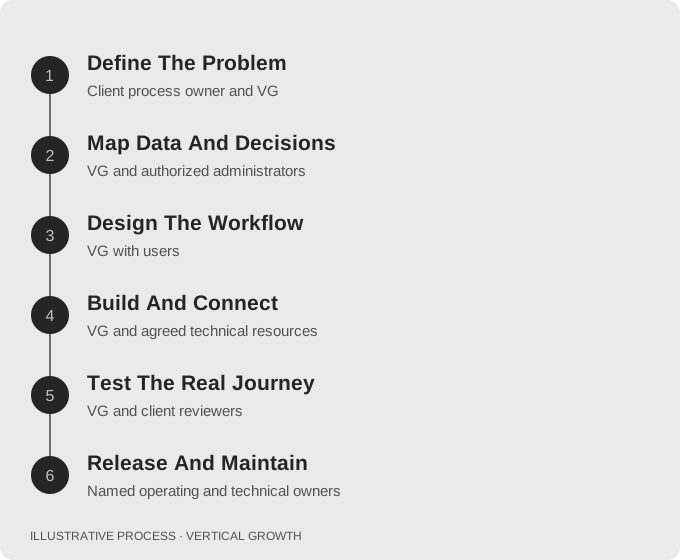
Define The Problem
Describe who needs to do what and where the current process fails.
Responsibility: Client process owner and VG
Map Data And Decisions
Identify systems, permissions, records, and human approvals.
Responsibility: VG and authorized administrators
Design The Workflow
Specify normal paths, exceptions, and meaningful success states.
Responsibility: VG with users
Build And Connect
Develop the scoped tools against verified account capabilities.
Responsibility: VG and agreed technical resources
Test The Real Journey
Verify outcomes at the receiving destination using controlled inputs.
Responsibility: VG and client reviewers
Release And Maintain
Monitor, document, back up, and retain a rollback path.
Responsibility: Named operating and technical owners
A Feature List Is Not A Workflow
The useful specification explains the user’s goal, required information, allowed actions, and what happens when something goes wrong. Access checks, duplicate handling, recovery, and meaningful error messages belong in the design rather than being added after the visible screen is complete.
Test Across The System Boundary
A frontend success message does not prove a CRM record was saved or a notification reached an inbox. Verify each material destination and retain safe evidence. If a vendor account does not support a required feature, report the dependency before promising the behavior.
Plan For The Next Change
Document access, secrets handling, backups, monitoring, dependencies, and deployment. A controlled release with a rollback route reduces avoidable uncertainty. This diagram describes a delivery approach, not a claim that a specific client platform has been implemented.