

The Workflow
An illustrative business process. The steps and responsibilities are adapted to the actual organization and engagement.
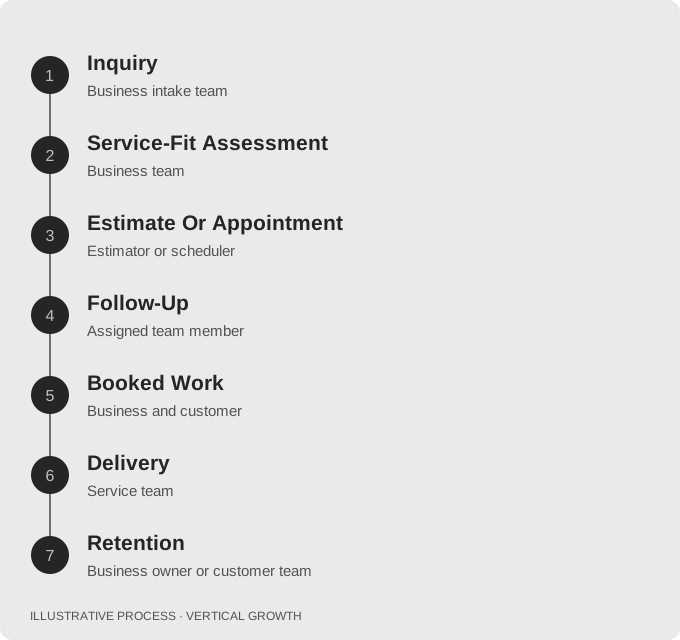
Inquiry
Receive a request and basic contact details.
Responsibility: Business intake team
Service-Fit Assessment
Check service area, job type, urgency, and available capability.
Responsibility: Business team
Estimate Or Appointment
Set the appropriate assessment or quoting step.
Responsibility: Estimator or scheduler
Follow-Up
Clarify open questions and track the customer’s decision.
Responsibility: Assigned team member
Booked Work
Confirm the agreed work and schedule.
Responsibility: Business and customer
Delivery
Carry out the agreed service and handle exceptions.
Responsibility: Service team
Retention
Support appropriate follow-up and future service needs.
Responsibility: Business owner or customer team
Marketing And Capacity Need To Agree
A campaign for a service the business cannot schedule creates friction for customers and staff. VG can help align acquisition with service areas, job types, estimate capacity, and delivery constraints. The team should know how to handle urgent requests and work outside the current scope.
An Estimate Is Not A Booking
Keep requested, scheduled, estimated, accepted, booked, completed, and cancelled work distinct. When an estimate remains open, assign a next action rather than letting it disappear in an inbox. If the customer chooses not to proceed, record the reason when it is known without guessing.
Use The Full Journey To Review Acquisition
Compare sources using relevant inquiries, estimate progress, booked work, and available delivery economics. Repeat business has value, but it should not be assumed for every customer. The conceptual flow shows where VG can improve handoffs and visibility; delivery quality remains the service business’s responsibility.