

The Workflow
An illustrative business process. The steps and responsibilities are adapted to the actual organization and engagement.
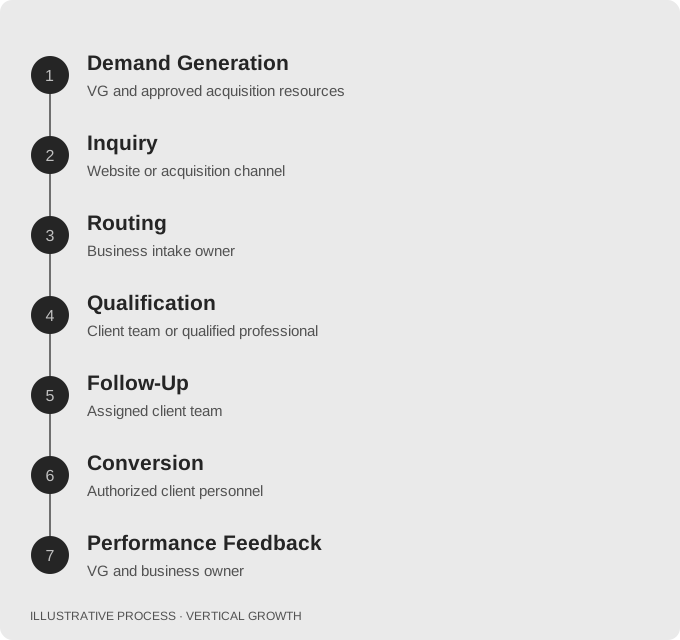
Demand Generation
Reach an appropriate audience with a clear, supportable offer.
Responsibility: VG and approved acquisition resources
Inquiry
Record a confirmed contact request with necessary context and permissions.
Responsibility: Website or acquisition channel
Routing
Send the request to a responsible person or queue.
Responsibility: Business intake owner
Qualification
Assess business fit and route professional decisions appropriately.
Responsibility: Client team or qualified professional
Follow-Up
Handle the next action, response, and applicable stop conditions.
Responsibility: Assigned client team
Conversion
Record the relevant confirmed outcome, such as a signed engagement or booked work.
Responsibility: Authorized client personnel
Performance Feedback
Connect source and stage outcomes to future decisions.
Responsibility: VG and business owner
An Inquiry Starts The Operating Work
The next team needs enough context to respond appropriately: source, requested service, relevant geography, and the person’s preferred or permitted contact route. It does not need unrelated sensitive information. VG can design the handoff and measurement model around the actual business.
Exceptions Need Their Own Path
Duplicates should link to the existing opportunity. Incomplete requests may need clarification. Unreachable contacts require an appropriate follow-up process. Poor-fit requests should receive a meaningful disposition. A failed transfer should be visible to someone who can recover it.
Measure Stages Without Calling Them Leads Indiscriminately
A click is engagement. A confirmed submitted inquiry is a captured contact request. Qualification and conversion depend on later events. Keeping these distinctions makes channel comparisons more useful and prevents activity from being reported as business value. This is a conceptual flow, not client performance evidence.